
Golden Streets Moving, a moving company in the United States, needed a moving company website that captured customers without losing a single contact. We built it remotely: a site with a two-step quote form, a dashboard to manage every request and a move scheduler. Today the owner sees each request the moment it arrives, with an internal price estimate and the calendar on one screen.
The problem: what was done by hand and what it cost
A moving company lives on fast replies. Someone planning a move usually asks several companies for a price on the same day, and the one that answers first, and clearly, wins.
This is the usual starting point for a moving company of this size, and what we set out to solve:
- Requests came in by phone, WhatsApp and Instagram, with no single record.
- Every quote depended on what the owner remembered and worked out on the spot.
- With a small crew, someone had to check by hand that two moves did not overlap.
- Changing a line of text or a rate on the website meant asking a developer.
None of that is a disaster on an ordinary day. But in peak season, every lost contact is a move that goes to another company.
Why custom software: compared with spreadsheets, accounting software or an off-the-shelf SaaS
These are the usual alternatives and why they did not fit:
- Spreadsheets: fine to start with, but they do not capture customers or tell you when one comes in. And when two people edit the same file, data gets overwritten.
- Accounting or ERP software: built for bookkeeping and invoicing. They are not designed to capture leads from a website or to schedule moves.
- An off-the-shelf CRM or SaaS: it works, but it usually charges a monthly fee per user and its pricing logic is not the one your business runs on. Adapting it often costs more than building what you need.
Custom software does one thing: your process, with your rules. Here that meant the quote following the owner's criteria, the order of statuses for each request and the limit on simultaneous moves. If you are looking for a website that generates quotes, that is where the value is: the quote follows your business rule, not a generic one.
How we built it, phase by phase
We work in closed phases, each with a defined scope and a fixed price agreed before we start. That way you know what you get and what you pay at each stage, with no surprises. These were the phases:
- Phase 1: website and online booking (4 weeks). The full marketing site (services, benefits, FAQ, reviews), adapted to mobile. It includes the first booking form with Google Maps address autocomplete and a basic dashboard to view requests.
- Phase 2: notifications and mobile polish (3 days). Every new request reaches the owner by email. We refined navigation on phones.
- Phase 3: professional email and analytics (5 days). We moved the email service to Resend, added delivery status to the dashboard and connected Google Analytics to measure visits.
- Phase 4: quote form and control panels (3 weeks). A two-step form, an internal price estimator, a rates panel and a content editor for the website.
- Phase 5: move calendar and daily summary (1 day). A calendar with capacity control and a summary of today's leads and upcoming moves.
In total: 37 code deliveries spread over 19 working days, across about 11 calendar months. Each phase can be used on its own, which is why the client did not have to wait for an "all done" to start receiving requests.
What this moving company website does
1. A website built to convert
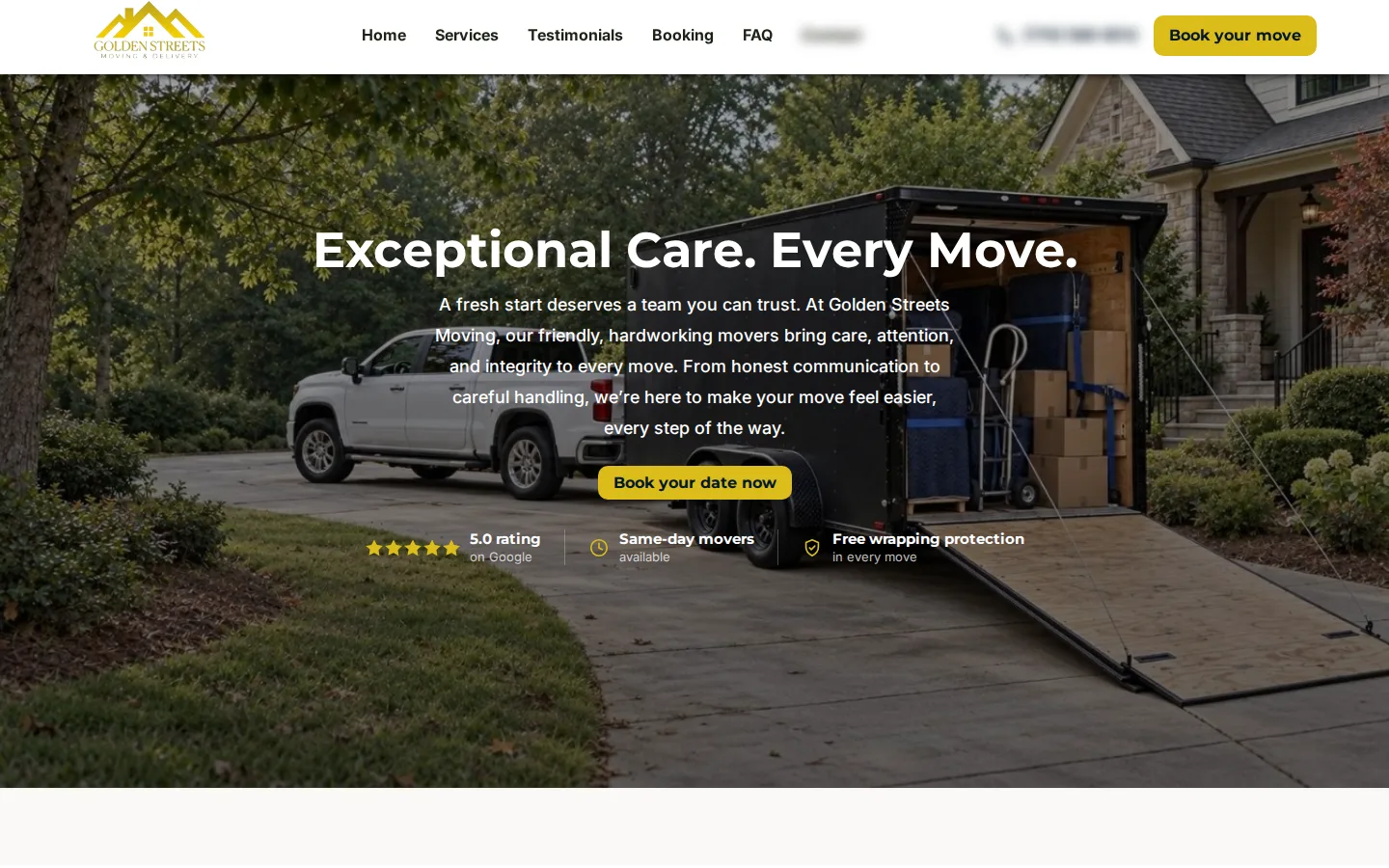
The home page says in one sentence what the company does, shows a loaded truck and pushes toward a single button: book. Below it, the benefits (insured moves, punctuality and professional service) and the services.
2. A two-step quote form that does not lose contacts
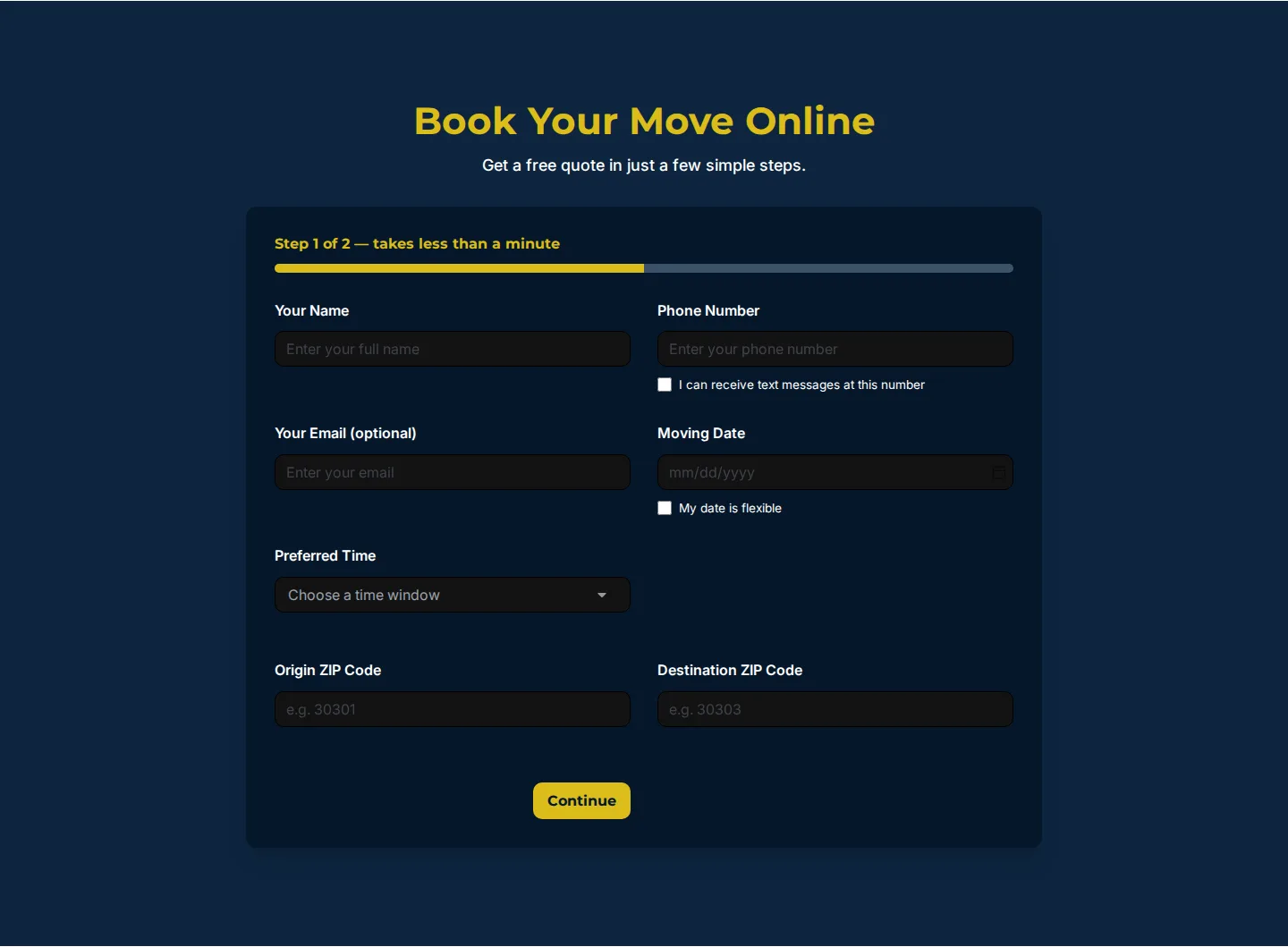
The first step asks only for the essentials: phone, date, time window and ZIP codes. As soon as the person clicks "Continue", the request is already saved. If they leave before finishing, the owner still has their contact. The second step collects the size of the move, floors, elevator access and special items.
3. It works well on a phone
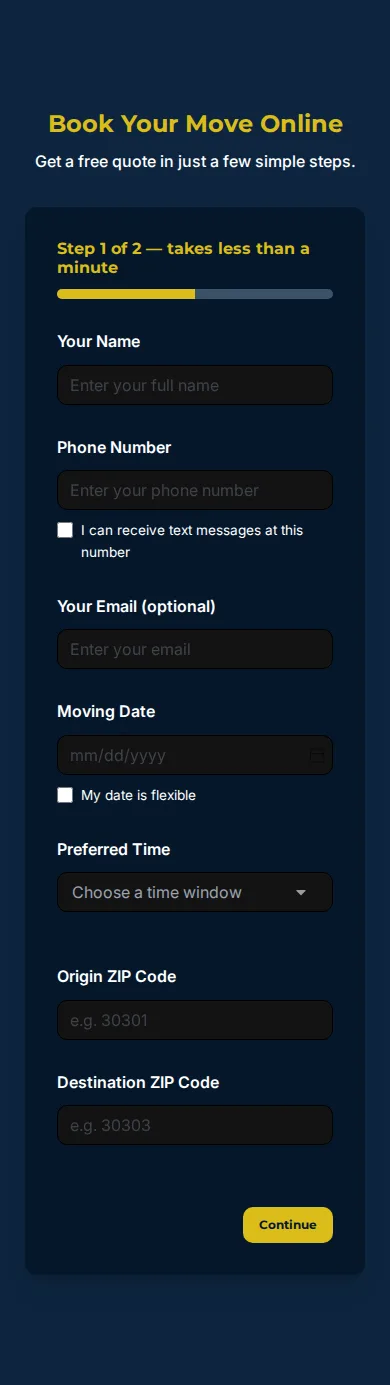
The site and the form adapt to phone screens, and they were designed with someone requesting a quote from their phone in mind.
4. Internal price estimator and rates panel
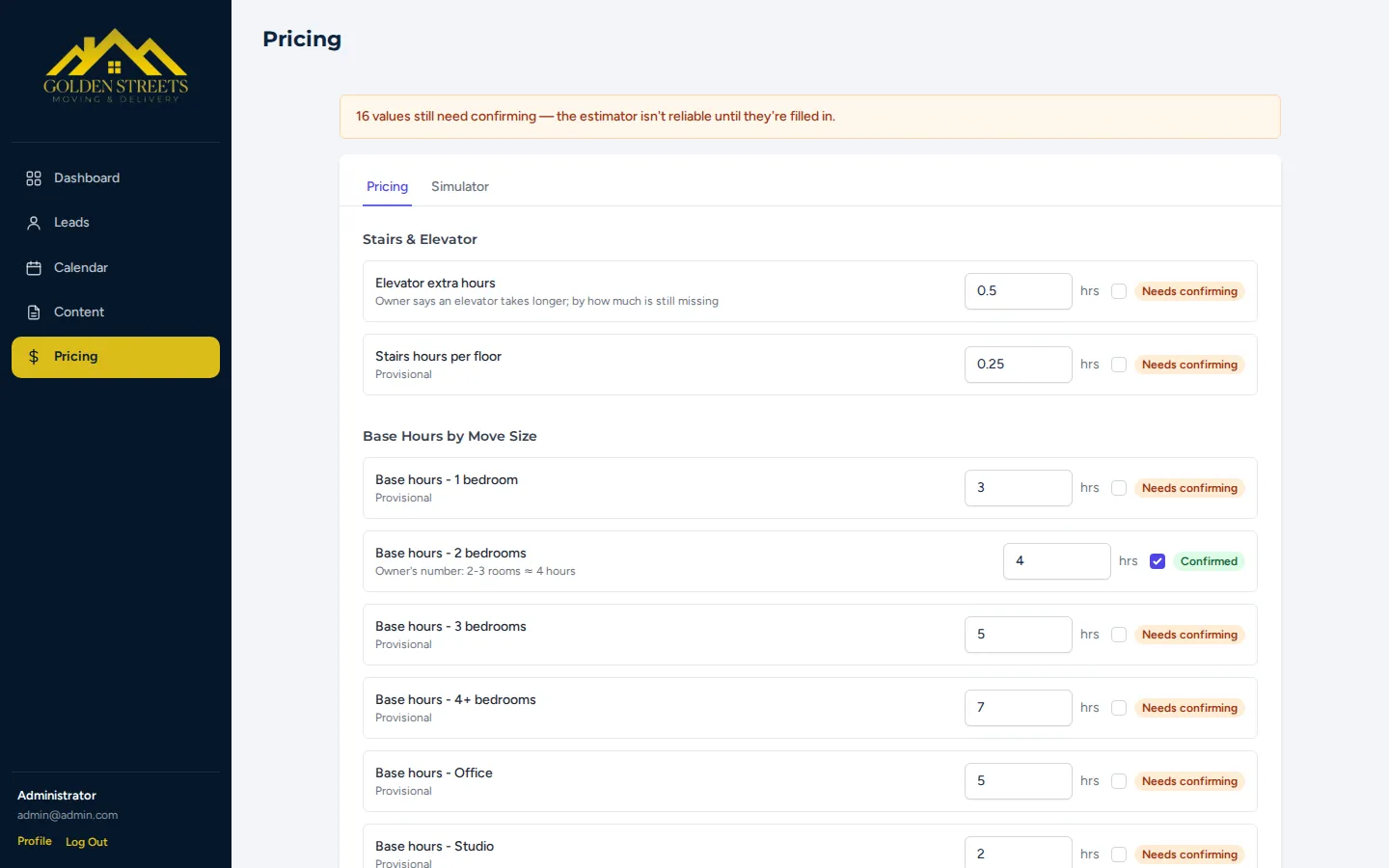
The system calculates hours and cost with the owner's rates, and that number goes only to the owner, never to the customer. The owner changes rates, base hours and surcharges from a panel, with a simulator to test them. Every value is marked as confirmed or provisional, and the panel shows how many are still to be confirmed.
5. Request inbox and move calendar
Each request goes through five statuses: pending, in review, scheduled, closed or cancelled. When a move is scheduled on the calendar, the status updates by itself, and the system warns if there are already too many moves at the same time.
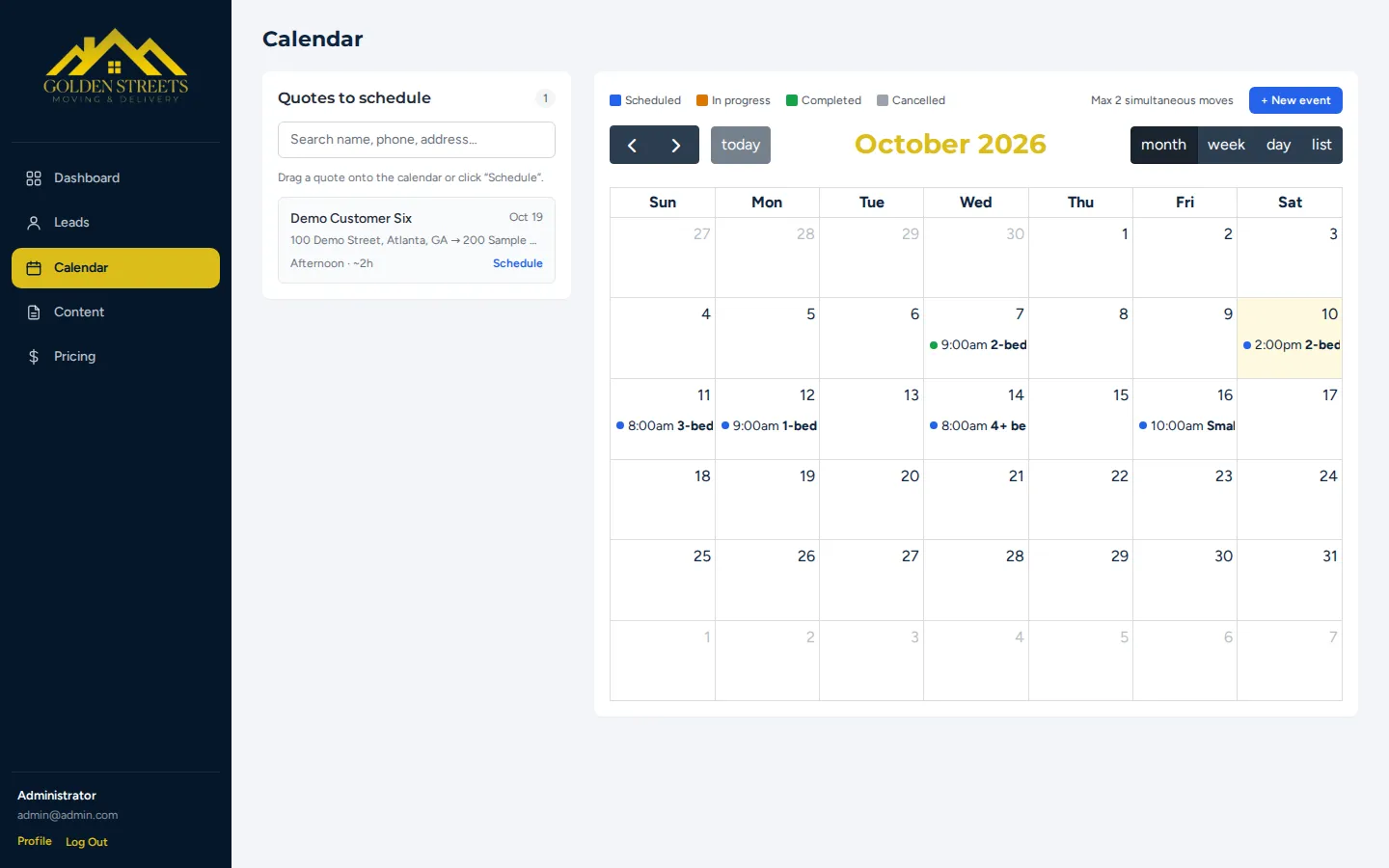
And when the owner opens the dashboard, they see on one screen today's and this week's leads, today's moves and the upcoming ones.
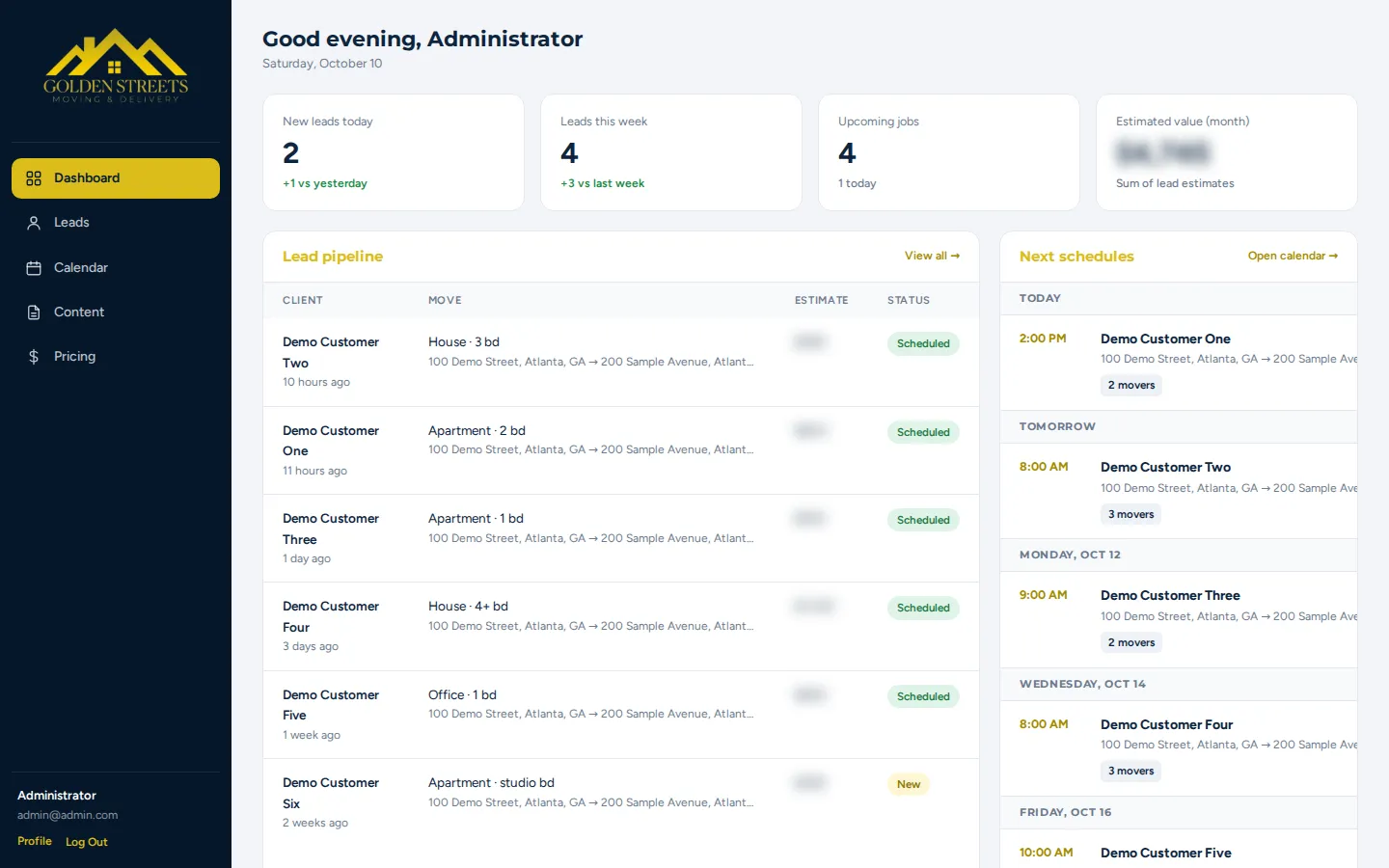
All dashboard screenshots use test data.
Technical decisions, explained without jargon
- Save the contact from the first step. A half-finished contact is worth more than none. That is why the request is saved before the person finishes the form.
- One calculator for everything. The public form and the dashboard simulator use exactly the same calculation. The two numbers can never contradict each other.
- Confirmed and provisional figures. If a rate is still undefined, the system flags it and says so in the owner's email. It prevents quoting with a made-up number without noticing.
- Distances without paying per lookup. We calculate the miles between two ZIP codes with our own table, instead of a paid API call for every quote. It has a margin of error, so it is only used to decide a distance surcharge.
Results
What we delivered:
- 5 admin screens (summary, requests, calendar, pricing and content).
- 5 tracking statuses for every request, from the first call to closing.
- 54 automated tests, 29 of them on the business's own rules (calculation, distance, booking, calendar and dashboard).
- An email alert for every request, with the full details.
We do not publish figures for requests per month or response times because we have not yet measured them together with the client. When we have them, this case will be updated.
Frequently asked questions
How much does a moving company website cost?
It depends on the scope. That is why we work in phases with a fixed price: you start with the website and the quote form, and add dashboards or scheduling when the business needs them. In the free session we review your case and give you a range.
How long does it take, and where does the site live?
The first phase of this project, with the website and online booking, took about 4 weeks. The timeline for your project depends on the scope, and we agree it phase by phase before we start. As for hosting, when the site runs on a cloud server your customers can use it from anywhere, and you only need internet to open the dashboard.
Is there support after launch?
Yes. We offer maintenance and ongoing support after launch. The code is documented and covered by automated tests, so future changes can be made without fear of breaking what already works.
Have a similar process? Book a free session. Tell us how you work today and we will tell you what can be automated.
- Learn about our custom software development for Georgia businesses
- Message us on WhatsApp
- Prefer to write? Book a free session